Friday, September 19, 2014

Revealed: What sets tectonic plates in motion

There are eight major tectonic plates that move above the earth’s mantle at rates of up to 150 millimetres every year and Earth is the only planet in our solar system with such a system in place.
The geological record suggests that until three billion years ago, the earth’s crust was immobile so what sparked this unique phenomenon has fascinated geologists for decades.
Photo by Indileak
“We suggest it was triggered by the spreading of early continents and then eventually became a self-sustaining process,” said Professor Patrice Rey from the University of Sydney’s school of geosciences.
In simple terms, the process involves plates being dragged into the mantle at certain points and moving away from each other at others, in what has been dubbed “the conveyor belt”.
Plate tectonics depends on the inverse relationship between density of rocks and temperature.
At mid-oceanic ridges, rocks are hot and their density is low, making them buoyant or more able to float.
As they move away from those ridges they cool down and their density increases until, where they become denser than the underlying hot mantle, they sink and are dragged under.
But three to four billion years ago, the earth’s interior was hotter, volcanic activity was more prominent and tectonic plates did not become cold and dense enough to spontaneously sink.
“So the driving engine for plate tectonics did not exist,” Rey added.
Instead, buoyant early continents erupted in the middle of immobile plates.
“Our model shows that these early continents could have placed major stress on the surrounding plates. Because they were buoyant they spread horizontally, forcing adjacent plates to be pushed under at their edges,” Rey pointed out.
The article appeared in the journal Nature.

Destination Mars: Mangalyaan enters the last leg of its journey

Photo by India times
It is a tiny spacecraft by interplanetary standards, but size does not matter in this endeavour. The Indian Space Research Organisation (ISRO) is not trying to do exotic scientific experiments on Mars at the moment.

This mission is simply to test the organisation's ability to take something all the way up to Mars, keep it in good health during the journey, and make it go around the planet. Doing experiments while orbiting Mars is useful, but it is not the core part of the mission.

 
On Monday next week, ISRO will face one of the biggest tests of this complicated project. It will switch on the engine that has been lying dormant for 10 months, and fire it for four seconds to slow down the spacecraft.

If it fires and performs well, ISRO will fire it for a longer duration two days later and ease the spacecraft into an orbit around Mars. If it fails to ignite on September 22, the space organisation will nudge the spacecraft's path towards a Martian orbit by firing eight  smaller thrusters on September 24. In either case, barring completely unexpected situations, the Mars orbiter is expected to reach its destination within a week.

Apart from a small glitch a few days after launch, the mission has gone very smoothly. The spacecraft has completed 98 per cent of its journey, and its trajectory is so close to the intended path that ISRO did not have to do a correction exercise planned for last month. 

"We have crossed several situations that we have not faced before," says ISRO Chairman K Radhakrishnan. "We are now preparing for all contingencies on September 24."

The Mars mission, as planned by ISRO, was a sophisticated exercise. Compared to other Mars missions, ISRO had a smaller rocket and payload. This reduced the cost significantly but increased the mission's complexity. Other Mars missions are not planned this way.

The Maven spacecraft of NASA, which will reach Mars a  few days before ISRO's orbiter, was on its way to the red planet directly after launch. All it required was a fiveminute push from the powerful upper stage of the rocket, just 27 minutes after lift-off. 

By India Times

Thursday, September 18, 2014

Advani qualifies for Indian Open

Pankaj Advani along with five others qualified for the Indian Open Championships after winning their respective knockout matches on Thursday.

In the qualifiers, which concluded at the PYC Hindu Gymkhana tables, Advani blanked Rafat Habib 4-0. India No. 5 Faisal Khan shocked India No 2 Kamal Chawla 4-2 in a two-hour encounter.

India No. 3 Brijesh Damani, Neeraj Kumar, Dharminder Lilly and Sumit Talwar also qualified.


Asian snooker gold medal-winning team member Faisal won 4-2 (68-24, 131(103)-00, 25-75, 78-51, 13-77(72), 78(59)-12) In the deciding frame Chawla led 12-0.

In another interesting match, Lilly of Punjab blossomed late in the seventh frame to make a comeback and scrape past Laxman Rawat 4-3 (74-11, 60-34, 10-64, 61-03, 05-60, 00-83, 64-50).

Rawat was 8 point up after which he missed a brown. Lilly had a break of 22, after potting brown, blue, pink and black to turn the tide in a two hour 30 min thriller. In the last frame Lakshman was up 8 points and missed on the brown. Dharmendra played calmly to clinch a break of 22 points potting brown, blue, pink and black to win the match.

In another closely fought match, Sumit Talwar of Chandigarh upset seasoned Alok Kumar of PSPB for the top spot winning 4-3 (67-22, 51-69, 33-69, 15-51, 62-16, 59-47, 59-56).

In the decider frame Alok Kumar led 31-7, Sumit Talwar made a unbeaten break of 46 to come back a score a creditable 3 point win.

Pankaj Advani of PSPB secured a easy win over Rafat Habib od Railways winning 4-0(84-51, 62-21, 69-05, 75(75)-00); Advani's teammate Brijesh Damani scored a 4-2 (53-57,51-41,81-414,68-36,14-72,49-04) win over Delhi's Anuj Uppal, while Railwayman Neeraj Kumar stopped the winning run of PSPB's Manan Chandra 4-1(79-16, 70-55, 86-28, 41-55, 83-37).

By Pune Mirror 

Asian Games 2014: Where mind is without fear

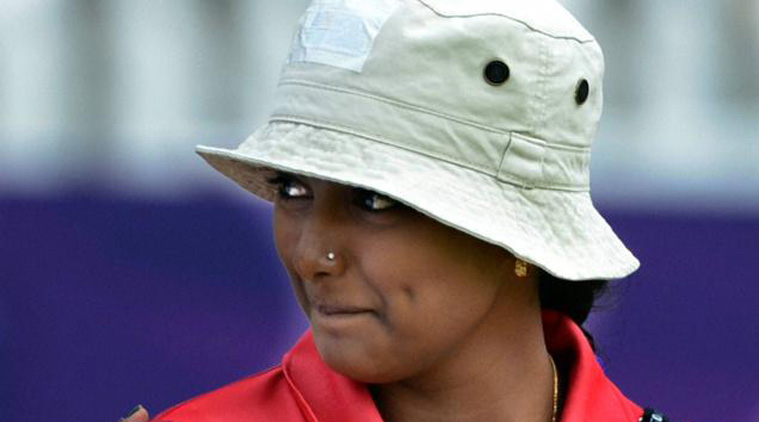
Deepika Kumari lets out a wry smile when you mention London and mental toughness in the same breath. At 18, she was among the youngest members of the Indian contingent at the Olympics two years ago.

Deepika Kumari ( Photo by Indian Express )


 The then world No. 1 was also the country’s brightest medal prospect. But in front of packed stands at Lord’s – a venue far too familiar to the Indians – the dramatic mental disintegration of the archer was astonishing. Unable to adapt to the windy conditions, she failed to hit a single bulls-eye and went down 2-6 in the first round to Englishwoman Amy Oliver. She hasn’t forgotten that morning, yet. “I haven’t been allowed to forget it,” she quickly adds. 

London wasn’t a solitary moment of failure for Deepika. It triggered a prolonged lean patch in her fledgling career; her staggering slump as dramatic as her prodigious rise. And it’s likely that those memories will come rushing back when she lines up against Asia and world’s best at the Gyeyang Asiad Archery Field. The windy and overcast conditions here left creases on her forehead.
This time, however, she insists she is better prepared. “The windy conditions will be the same for everyone. It will depend a lot on how I feel that day, my body condition and mental state,” she says, as she checks into the Games Village, clinging on to a giant teddy.
How well she adapts to the conditions will be the key in determining where she finishes on the podium – if she finishes on the podium. It’s solely for this purpose that the archers were the first to reach South Korea, a good two weeks before the others. India’s Korean coach Lim Chae Woong brought the team to Gwangju, nearly 250km from Incheon, to train with some local archers.

For a couple of days, even reigning Olympic and world champion archer Ki Bo-Bae joined the Indian contingent. “It has helped a lot in terms of preparation. I have worked on a few specific aspects like playing in front of crowds and keeping a cool mind. We have practised in front of crowds. Even though the atmosphere at the Asian Games will be quite different, it helped. Let’s see how things unfold during competition,” Deepika says.

You can sense that the lost confidence is slowly returning. Deepika says it’s the return to her old coach and old bow that has done the trick. A few months ago, she slipped to 19th in the rankings following a string of poor results this year and failed to make it to the senior squad for the Stage I and III World Cups.

To arrest her slide, she returned to Dharmendra Tiwary, who coached Deepika in the early years of her career. The reunion was more to prep her psychologically than technically, Tiwary says. “She gets nervous before big matches. Even before the continued…


Asian Games: Shooter Abhinav Bindra 'used to' federations messing up

 India's only individual Olympic gold medallist, Abhinav Bindra has expressed anguish and disappointment over the seeming apathy of the country's sports administrators, saying he has "got used" to such things.
Abhinav Bindra ( Photo by First post )
He wanted to check into the Asiad Games Village early but could not make it till yesterday evening, two days after his preferred date, as the event organisers were unable to send accreditation cards for Bindra and other members of the Indian shooting squad because the national federation had not sent their entries on time.
The rifle ace was in for disappointment on arrival too, as no Indian official was at the airport to receive him and hand over his accreditation card. He had to complete customs formalities for the release of his equipment on his own.
"What can I do? But it would have been nice to come in early," Bindra said.
He added: "I have got used to these things. Nothing surprises me anymore."
He said he can only concentrate on his event and give his best.
Bindra had won a historic gold medal in 10-metre Air Rifle at the 2008 Beijing Olympics.
India's shooters are hoping to extend their success at the Glasgow Commonwealth Games, where they won 17 medals, including four golds.
At the 2010 Asian Games in Guangzhou, China, India participated in 35 sports and won 65 medals, including 14 golds.

Thursday, September 11, 2014

Hockey India slams Govt for cutting down on support staff

New Delhi: Hockey India on Wednesday described the government's decision to exclude their four key support staff, including a coach, from the Asian Games-bound contingent as "distraction", leaving their High Performance Director Roelant Oltmans in a state of "shock".
India's national game also had to face the brunt of the government's decision to prune down the Indian contingent for the Incheon Asian Games to 679 from 942 after men's team coach Jude Felix and scientific advisor Matthew David Eyles, and women's side physiotherapist Gaurav Mehra and video analyst Amutha Prakash were not cleared for the September 19 to October 4 quadrennial event.
Photo by IBN live
Even though the move didn't go down well with Oltmans, he said both the men's and women's teams are focussed to deliver the goods despite the absence of the specialists.
"I am shocked. In 30 years of my professional career, I haven't encountered such a scenario. It is impossible to manage a team without people in specific roles," Oltmans said on the sidelines of sending-off ceremony for the teams held at HI secretary Narinder Batra's residence on Wednesday.
"We were supposed to leave tomorrow but we still don't know when we are flying because we haven't got our tickets yet. These are all distracting us and throwing our plans haywire.
"Our main focus now is to stay away from all these distractions and make sure that we perform to the level which we are capable of and if we do so, we have a fair chance," the legendary Dutchman said.
Indian men's team's chief coach Terry Walsh is also "disturbed" and "surprised" by the last-minute problems.
"I just heard about some of these possible issues. Seems somewhat far-fetched to me. I can't control any of that so leave it to the people who can," he said.
"Well this makes me really disturbed. We still don't know as to which day we leave and it is really important, that's actually is quite critical. It's another of those issues which we can't control but we are working around. It is somewhat surprising that these things are happening at this stage of preparation," Walsh said.
"We have got plans but things get changed. We don't get too bothered by it we just have to deal with the situation put in front of us."

Mary Kom ready for the Incheon challenge

Women’s boxing superstar M.C. Mary Kom is an ageless beauty on the canvas. A mother of three, the 31-year-old Mary Kom has redefined the scope for an Indian woman athlete by making two comebacks after child birth.
A five-time world champion and a London Olympics bronze medallist, Mary Kom is now stretching herself to the limit at the Indira Gandhi Indoor Stadium here in order to be fighting fit for the upcoming Incheon Asian Games.
Mary Kom ( photo by The hindu)
Returning to action after a two-year layoff, which witnessed the birth of her third child and two surgeries, Mary Kom is neither physically affected nor mentally exhausted.
“My dream (of winning a gold medal) was not fulfilled in the last Olympics. That’s why I came back.
“I am trying my best to fulfil my dream. After (London) Olympics, I had a baby.
“The comeback was faster than the last time as the Commonwealth Games and Asian Games were approaching very fast. I am happy that I have regained fitness,” Mary Kom told The Hindu.
“After remaining out of the ring for two years, it was very hard to return. I had two surgeries — one for the delivery and one for the removal of the gall bladder. We face so many problems in life, but fight back. This is my passion and this is what I love to do. I always try to win a medal for the country, but even if I do not win a medal I enjoy the experience.”
Asked about her expectations at Incheon, Mary Kom, a bronze medallist in the 2010 Asiad, refrained from predicting anything.
“I cannot say anything about the competition. Anything can happen.
“I have a lot of experience and I will manage (even without any competitive exposure prior to the Games). In the Asian Games all the opponents from different countries are the same.
“I just train hard and keep focus.”
Mary Kom, who will compete in the 51kg category, said she did not have any butterflies in her stomach even as she was about to take part in a top-level competition after a long gap.
“When I go into the ring, I do not have any different feeling. I have been practising and now I am hundred per cent fit and in my old form.”
Mary Kom asserted that she felt as young as ever while stepping into the ring.
“I have no idea about the age factor. I will go for the Rio Olympics and let’s see what happens in between,” she said.